




For centuries, Tibetan artisans have transformed handwritten Buddhist texts into extraordinary works of art. Beyond the elegant forms of the Tibetan script, many traditional manuscripts feature brilliant gold and silver lettering, intricate decorative borders, and exquisitely detailed paintings of Buddhas, bodhisattvas, and other sacred figures. These embellishments belong to a rich artistic tradition known as manuscript illumination, in which the written word and visual art come together to create objects of both beauty and religious significance.
In Tibet, the creation of an illuminated manuscript was often much more than an exercise in artistic refinement. Buddhist scriptures were regarded as physical representations of the Buddha’s teachings, and their careful production could itself become an expression of devotion. The materials chosen, the precision of the lettering, and the elaborate decorations all reflected the reverence with which these texts were treated.
Today, surviving examples of Tibetan illuminated manuscripts offer a fascinating glimpse into the artistic, religious, and cultural traditions that flourished across the Tibetan plateau and the wider Himalayan world.
What Is Manuscript Illumination?
The term manuscript illumination generally refers to the artistic decoration of handwritten books, particularly through the use of gold, silver, colorful pigments, ornamental designs, and painted illustrations. Although the term is most frequently associated with medieval European manuscripts, similar traditions developed independently in many parts of Asia, including Tibet, Nepal, India, and China.
In Tibetan manuscripts, illumination can take numerous forms. Some examples feature only a few decorative elements, such as an embellished title or an ornamental border surrounding the opening lines of a text. Others are extraordinarily elaborate, incorporating miniature paintings, richly colored backgrounds, and lettering executed entirely in precious metals.
The distinction between calligraphy and illumination is an important one. Calligraphy concerns the artistic formation and arrangement of written characters, while illumination encompasses the visual ornamentation that accompanies the writing. In practice, however, the two traditions frequently overlap. A manuscript written in gold ink, for example, demonstrates both the calligrapher’s mastery of letterforms and the illuminator’s knowledge of specialized materials and techniques.
The Historical Development of Tibetan Manuscript Illumination
The development of Tibetan manuscript art is closely connected to the transmission of Buddhism from India into Tibet, beginning in the seventh century. As Buddhist teachings were translated into Tibetan and monastic institutions gradually emerged, the production and preservation of written texts became increasingly important.
Early Tibetan manuscripts were influenced by the bookmaking traditions of neighboring Buddhist cultures, particularly those of India and Nepal. The long, rectangular format of Indian palm-leaf manuscripts helped shape the Tibetan pecha, a format consisting of loose, elongated pages traditionally stacked between protective wooden covers.
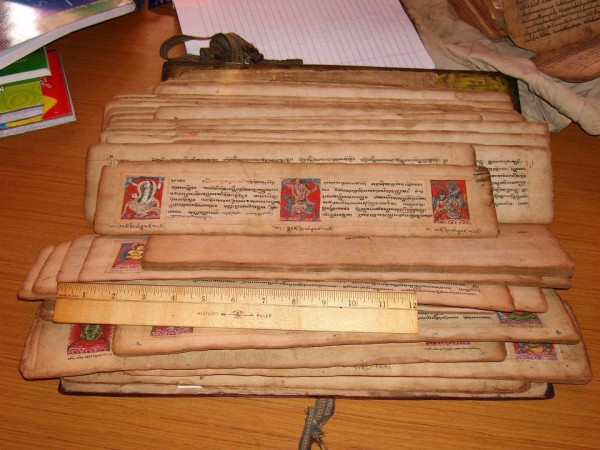
Over time, Tibetan artisans adapted these inherited conventions to their own materials, aesthetic preferences, and religious practices. Paper replaced palm leaves as the principal writing surface, while distinctive Tibetan calligraphic styles developed alongside increasingly sophisticated forms of manuscript decoration.
By the medieval period, Tibetan manuscript production had become an important artistic activity associated with monasteries, religious patrons, and centers of learning. Wealthy individuals and institutions sometimes commissioned lavishly decorated copies of important Buddhist scriptures, including the Kangyur, the collected translations of the Buddha’s teachings, and the Tengyur, the extensive collection of translated Indian commentaries and treatises.
The creation of such manuscripts could require the coordinated efforts of numerous specialists, including papermakers, scribes, painters, pigment preparers, and craftsmen responsible for producing the protective covers.
Some manuscripts were relatively modest in appearance, while others represented extraordinary investments of time, skill, and valuable materials. Together, they demonstrate the remarkable range of Tibetan bookmaking traditions.
Gold and Silver: The Use of Precious Metals in Sacred Writing
Among the most striking features of Tibetan illuminated manuscripts is the use of gold and silver lettering. In particularly elaborate examples, entire pages, or even extensive collections of texts, were written using inks prepared from precious metals.
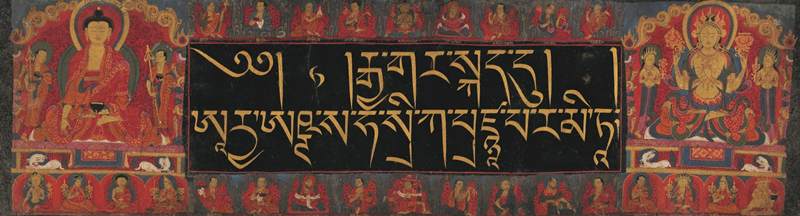
Gold held a special place in Buddhist artistic traditions. Its brilliance, durability, and association with preciousness made it especially appropriate for representing sacred subjects. Gold was widely employed in Buddhist sculpture, painting, and ritual objects, and its use in manuscripts similarly conveyed reverence for the teachings.
To produce metallic lettering, artisans could prepare finely divided gold or silver and combine it with a suitable binding medium. The resulting material was applied using specialized writing implements and techniques. The preparation of such inks required considerable care, as the consistency and behavior of metallic particles differ from those of ordinary carbon-based writing inks.
Some of the most visually dramatic manuscripts feature gold lettering against a deep blue or nearly black background. The contrast creates a luminous effect in which the written characters appear to emerge from the darkness of the page.
Silver was also employed, sometimes in combination with gold to distinguish particular passages, headings, or decorative elements. In certain manuscripts, the alternating use of precious metals contributed to a carefully planned visual composition.
The decision to write a scripture in gold or silver was not merely decorative. Precious materials represented a substantial offering, and their use could express the patron’s devotion and respect for the Buddhist teachings.
The Beauty of Dark Blue and Black Manuscript Pages
One of the most recognizable forms of Tibetan manuscript illumination involves the use of dark-colored paper, particularly deep blue or black surfaces embellished with gold or silver writing.
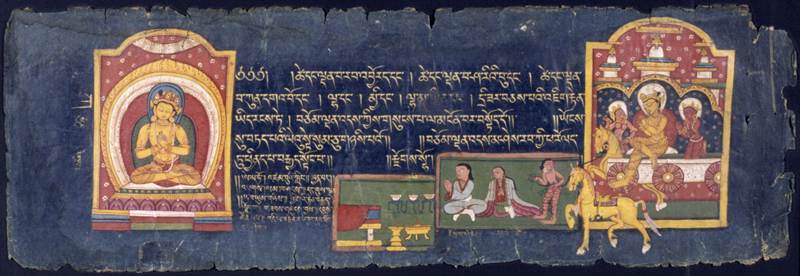
These manuscripts possess a distinctive visual character. Rather than relying on dark ink against a pale background, they reverse the conventional relationship between text and writing surface. The page becomes a rich, dark field upon which metallic letters and colorful illustrations stand out with exceptional clarity.
The production of such pages required additional preparation. Paper could be colored or coated with dark pigments and then carefully finished to create a surface suitable for writing. The quality of the surface was especially important, since metallic inks needed to adhere properly while retaining the sharp edges and delicate proportions of the Tibetan letters.
In some examples, dark pages were further embellished with painted borders, floral designs, and religious imagery. Gold lettering might be accompanied by red, blue, green, and white pigments, creating compositions of remarkable richness.
Although these manuscripts are often admired for their luxurious appearance, their beauty also reflects a sophisticated understanding of materials. The relationship between the prepared paper, the metallic ink, and the calligrapher’s technique was essential to the success of the finished work.
Miniature Paintings and Sacred Imagery
Tibetan illuminated manuscripts frequently incorporate painted images alongside the written text. These illustrations may depict Buddhas, bodhisattvas, tantric deities, lineage masters, or scenes associated with Buddhist teachings and religious history.
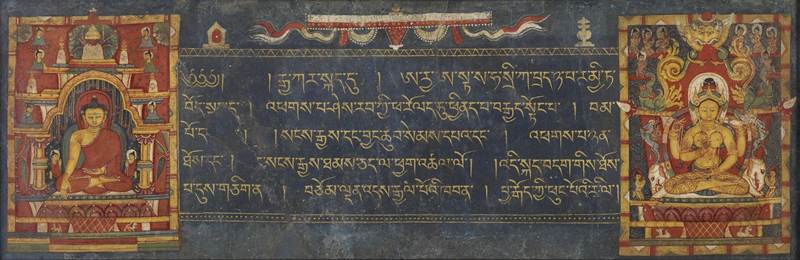
In many traditional pecha manuscripts, painted images appear near the beginning of the text, sometimes occupying specially prepared spaces within the opening folios. Their placement creates a visual introduction to the scripture and may identify important figures associated with its teachings or transmission.
The paintings themselves often follow conventions familiar from Tibetan religious art, particularly thangka painting. Figures may be shown seated upon lotus thrones, surrounded by halos, decorative architectural elements, or intricate floral designs.
The colors and attributes of these figures are not necessarily arbitrary. Tibetan Buddhist iconography employs established visual conventions through which posture, gesture, implements, and other features communicate particular religious meanings.
Creating such miniature paintings required exceptional precision. Unlike a large thangka, the artist worked within the narrow dimensions of a manuscript page, often rendering elaborate details on a very small scale.
The resulting images demonstrate how Tibetan manuscript illumination brought together two highly developed artistic disciplines: the precise construction of written characters and the equally demanding art of religious painting.
Decorative Borders, Floral Motifs, and Ornamental Designs
Beyond precious-metal lettering and miniature paintings, Tibetan manuscripts may feature a wide variety of ornamental decorations.
These include floral patterns, scrolling vines, geometric arrangements, auspicious symbols, and decorative frames surrounding the text. Some designs are relatively restrained, while others cover substantial portions of the page.
The lotus is among the most familiar motifs in Buddhist art. Associated with purity and spiritual awakening, it appears in numerous decorative contexts, including manuscript illustrations and ornamental borders.
Other motifs draw upon the broader artistic vocabulary of Tibetan and Himalayan Buddhism. Their appearance may reflect regional artistic traditions, the preferences of particular workshops, or the religious significance of the text being copied.
Decorative elements also serve a compositional purpose. Borders can organize the visual space of a page, distinguish important passages, and create a sense of balance between the written text and its surrounding ornamentation.
In the finest examples, the decoration does not compete with the calligraphy. Instead, the various elements are carefully integrated into a unified composition in which writing and ornament complement one another.
The Art of Illuminated Pecha Covers
The artistic treatment of Tibetan manuscripts was not limited to their pages. The protective covers used to enclose traditional pecha books could themselves become elaborate works of art.
Tibetan pechas generally consist of loose rectangular folios placed between two rigid covers, often made of wood. These covers protect the manuscript and help maintain the orderly arrangement of its pages.
For particularly important texts, the covers might be carved, painted, gilded, or otherwise embellished. Some feature intricate floral patterns, sacred imagery, or decorative designs executed in relief.
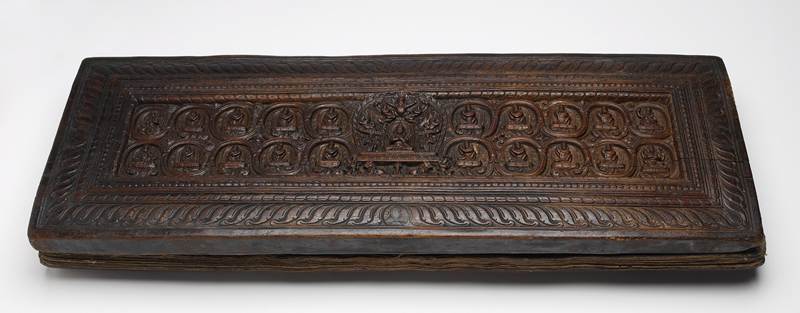
The exterior of a manuscript could therefore communicate something of its religious importance even before the pages were opened.
Decorative covers also reveal the collaborative nature of Tibetan book production. Whereas the writing and painting of a manuscript required the skills of scribes and illuminators, elaborate wooden covers called upon the expertise of carvers, painters, and other craftsmen.
When viewed together, the manuscript and its covers formed a complete artistic object, bringing several traditional crafts into a single expression of religious devotion.
The Religious Significance of Creating Beautiful Manuscripts
To understand Tibetan manuscript illumination fully, it is necessary to consider the religious significance of Buddhist scriptures themselves.
In Tibetan Buddhism, sacred texts are traditionally treated with considerable respect. They are understood not simply as repositories of information but as physical supports for the Buddha’s teachings. Their production, preservation, and dissemination have long been regarded as meritorious activities.
Commissioning the copying of a scripture could therefore represent an important religious undertaking. The resulting manuscript might be offered to a monastery, preserved in a temple, or produced as part of a larger devotional project.
The use of precious materials and elaborate decoration added another dimension to this activity. Gold, silver, fine pigments, and carefully prepared paper represented offerings of material resources, while the labor involved in producing the manuscript represented an offering of time and skill.
This helps explain why some Tibetan scriptures were produced with such extraordinary care, even when simpler materials would have been entirely sufficient for preserving the text.
The purpose was not necessarily to make the manuscript more readable or practical. Rather, the beauty of the object could itself express the value attributed to the teachings it contained.
Manuscript Illumination and the Tradition of Tibetan Calligraphy
Although manuscript illumination encompasses a broader range of artistic techniques, Tibetan calligraphy remains central to the finished work.
The formation of the letters determines much of the manuscript’s visual rhythm. Their proportions, spacing, alignment, and consistency establish the underlying structure upon which the decorative elements are arranged.
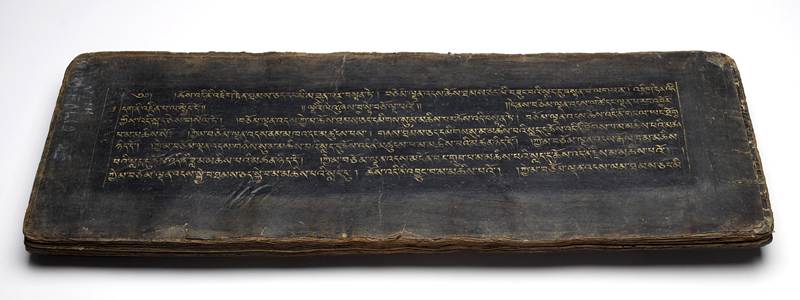
In manuscripts written with metallic inks, the relationship between material and technique becomes especially important. Gold and silver preparations may behave differently from ordinary ink, requiring adjustments to the writing process while preserving the proportions of the script.
The calligrapher must also work in harmony with the manuscript’s overall design. Spaces may be reserved for illustrations, decorative headings, or ornamental elements, requiring careful planning before the writing begins.
This integration of writing and decoration is one of the most compelling aspects of Tibetan manuscript art. Rather than treating the text as something separate from its visual presentation, the manuscript becomes a unified composition in which every element contributes to the whole.
For students of Tibetan calligraphy, illuminated manuscripts provide valuable examples of how traditional letterforms can function within elaborate artistic settings without losing their clarity, discipline, or distinctive character.
Preserving the Legacy of Tibetan Illuminated Manuscripts
Today, Tibetan illuminated manuscripts are preserved in monasteries, libraries, museums, and private collections around the world. Many surviving examples are centuries old, and their continued existence provides important evidence of historical Tibetan artistic and literary traditions.
Their preservation presents particular challenges. Paper, pigments, metallic inks, and wooden covers may respond differently to environmental conditions, while repeated handling can place additional stress on fragile materials.
Conservation specialists must therefore consider the manuscript as a complex object composed of several interacting materials, each with its own requirements.
Digitization has also created new opportunities for studying these works. High-resolution images allow scholars, artists, and the general public to examine details that might otherwise be difficult to access, including individual letterforms, decorative motifs, and the subtle textures of painted surfaces.
For contemporary calligraphers, these historical manuscripts remain an extraordinary source of inspiration. They demonstrate the possibilities that emerge when technical mastery, artistic imagination, and reverence for the written word come together.
A Living Legacy of Sacred Art
Tibetan illuminated manuscripts stand among the most beautiful achievements of the Himalayan artistic tradition. Their luminous lettering, richly colored paintings, and intricate ornamentation reveal a culture in which the written transmission of knowledge could also become an act of profound artistic expression.
Yet their significance extends beyond their visual splendor. These manuscripts embody the dedication of generations of scribes, painters, artisans, and patrons who regarded the preservation of Buddhist teachings as a worthy undertaking.
For those interested in Tibetan calligraphy, they offer a reminder that writing has historically occupied a place within a much larger world of artistic and religious craftsmanship. The individual letter, carefully formed upon the page, becomes part of something greater: a work in which language, beauty, and devotion are inseparably intertwined.
