




For centuries, the written word has occupied a central place in Tibetan civilization. From the great monastic libraries of Tibet to the modest shrines of individual practitioners, religious texts have served as repositories of knowledge, instruments of spiritual practice, and objects of profound reverence. Among the most recognizable expressions of this literary heritage is the pecha, the traditional Tibetan book distinguished by its long, narrow pages and unbound format.
Unlike the bound books familiar to most modern readers, a pecha consists of individual rectangular leaves stacked in sequence, often protected between wooden boards and wrapped in cloth. Its unusual proportions, distinctive materials, and elaborate methods of production reflect centuries of cultural exchange, artistic development, and religious devotion.
To understand the pecha is to appreciate not only a traditional form of bookmaking, but also the remarkable relationship between writing, craftsmanship, and the transmission of Buddhist teachings.
The Origins of the Tibetan Pecha
The history of the pecha is closely connected to the introduction of writing and Buddhism into Tibet. The Tibetan script is traditionally attributed to Thonmi Sambhota, a seventh-century figure associated with the reign of King Songtsen Gampo. According to traditional accounts, Thonmi Sambhota traveled to India, studied Indian writing systems, and developed the Tibetan alphabet to accommodate the sounds and grammatical structure of the Tibetan language.
Although the precise historical circumstances surrounding the script’s creation remain subjects of scholarly discussion, the development of a Tibetan writing system was a decisive event in the country’s cultural history. It made possible the translation of an immense body of Buddhist literature and the emergence of a distinctive Tibetan literary tradition.
The physical form of the pecha owes much to earlier Indian manuscript traditions. In India, religious and scholarly texts were commonly written on long, narrow palm leaves, which were stacked together and sometimes secured with cords passing through holes in the leaves. This format, known as the pothi, provided an important model for the manuscripts that subsequently appeared in Tibet.

As Buddhist texts were translated from Sanskrit into Tibetan, the physical conventions of Indian manuscripts were adapted to local conditions. Palm leaves were not readily available in the Tibetan highlands, and handmade paper gradually became the principal writing material. The long, horizontal shape of the Indian manuscript, however, was retained.
Over time, this inherited format developed into the distinctive Tibetan pecha, a book form that would remain remarkably consistent for more than a thousand years.
The Distinctive Structure of a Pecha
The most immediately recognizable feature of a pecha is its elongated rectangular shape. Its pages are considerably wider than they are tall, with text arranged in horizontal lines running from left to right. Each leaf is read on one side and then turned over to continue reading on the reverse.
The individual leaves are not sewn or glued together. Instead, they remain loose and are arranged in a carefully maintained sequence. Page numbers, traditionally written in Tibetan, help preserve the proper order.
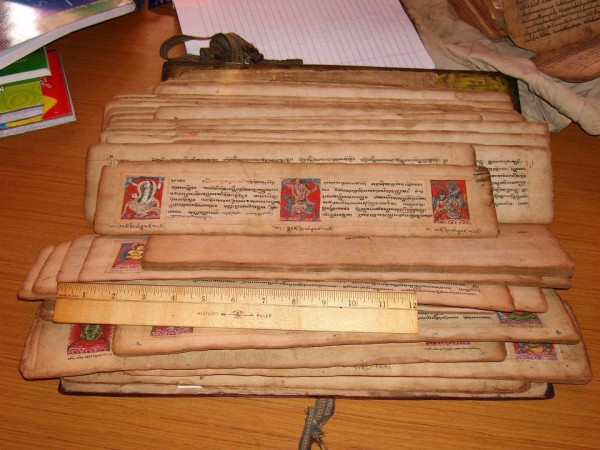
The dimensions of pechas vary considerably according to their purpose, age, and place of production. Small, portable editions might contain prayers or ritual instructions, while larger volumes were produced for extensive philosophical treatises, canonical collections, and ceremonial use.
Many traditional pechas are protected by a pair of wooden boards placed above and below the stack of pages. These boards may be plain and functional or richly decorated with carving, painting, gilding, and religious imagery. The entire volume is often wrapped in cloth, sometimes with an additional protective textile cover.
In monastic libraries, pechas are commonly stored horizontally on shelves or in compartments, with their wrapped volumes arranged in orderly stacks. Cloth labels or identifying tags help readers locate particular texts without disturbing an entire collection.
This system of storage is both practical and culturally significant. The book is treated not merely as an object containing information, but as a physical support for teachings that have been preserved and transmitted across generations.
Traditional Tibetan Papermaking
One of the most fascinating aspects of pecha production is the paper itself. Before the widespread availability of industrially manufactured paper, Tibetan manuscripts depended on the labor-intensive craft of handmade papermaking.
Traditional Tibetan paper was produced from several kinds of plant fibers, particularly the inner bark and roots of certain shrubs native to the Himalayan region. Plants belonging to the genera Daphne, Edgeworthia, and Stellera have all been associated with Himalayan and Tibetan papermaking traditions, although the materials and methods varied by region.
The fibers were collected, cleaned, cooked or otherwise softened, and beaten into pulp. The prepared pulp was then dispersed in water and formed into sheets using specialized papermaking screens or molds.
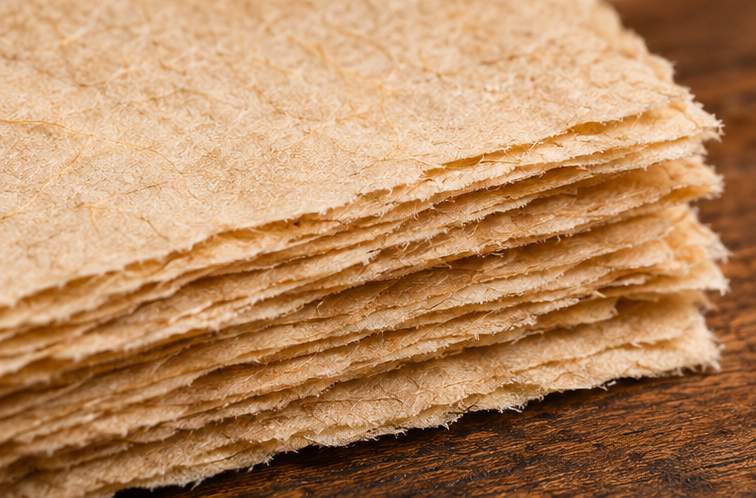
The resulting paper could possess a remarkable combination of strength, flexibility, and durability. Its long fibers helped resist tearing, while the characteristics of certain plant materials could make the sheets less attractive to insects.
Not all Tibetan paper was identical. Some varieties were thin and supple, while others were comparatively thick and substantial. Differences in fiber preparation, beating, sheet formation, and finishing produced papers with distinctive textures and writing qualities.
For a calligrapher, these differences are especially important. A well-prepared sheet must accommodate the movement of the pen while controlling the absorption of ink. Paper that is too absorbent allows strokes to spread and lose definition, while an excessively hard or uneven surface can interfere with the natural movement of the writing instrument.
Traditional papermakers and scribes developed techniques for improving the writing surface, including polishing, burnishing, and various forms of surface preparation. The result was a material carefully suited to the demands of manuscript production.
The survival of centuries-old Tibetan manuscripts is a testament not only to the care with which they were preserved, but also to the skill of the artisans who made their paper.
Calligraphy and the Art of the Manuscript
Before the widespread adoption of woodblock printing, Tibetan Buddhist texts were reproduced by hand. This required an extraordinary investment of time and skill, particularly for extensive works containing hundreds or thousands of pages.
The scribes responsible for copying these texts were expected to maintain a high degree of consistency in letter formation, spacing, alignment, and overall composition. A manuscript’s readability depended upon the careful relationship between the proportions of individual letters and the arrangement of text across the page.
The formal Tibetan script known as Uchen, distinguished by its prominent horizontal headstrokes, became particularly important in the production of religious manuscripts. Its clear, structured forms were well suited to the demands of preserving lengthy texts.
Other Tibetan writing styles were also employed, depending on the period, region, and intended purpose of a manuscript.
The long, narrow proportions of the pecha created particular compositional challenges. Lines of writing had to remain visually balanced across an extended horizontal surface, while margins, page numbers, ornamental elements, and occasional illustrations had to be accommodated without disrupting the text.
Some of the most elaborate manuscripts were written in gold or silver ink on dark-colored paper. These luxurious volumes, often commissioned by religious institutions or wealthy patrons, could require enormous resources to produce.
The use of precious materials reflected the religious importance of the texts themselves. Copying a Buddhist scripture was understood not simply as an exercise in transcription, but as an act capable of generating spiritual merit.
Within this tradition, calligraphy occupied a position where technical discipline and religious devotion could become closely intertwined. The careful execution of each letter was part of a larger undertaking: preserving the teachings accurately and presenting them in a form worthy of respect.
The Transformation Brought by Woodblock Printing
The introduction and expansion of woodblock printing transformed the production and circulation of Tibetan books. Although manuscript copying continued, printing made it possible to reproduce texts in greater numbers without requiring every page to be written anew.
Woodblock printing had developed in China centuries earlier and became an important technology throughout East Asia. In Tibet, the production of printed Buddhist texts expanded significantly during the medieval period, with major printing establishments emerging in subsequent centuries.
The process began with the preparation of a carefully written master copy. A calligrapher or scribe arranged the text in the precise form in which it was intended to appear on the finished page.
The written design was then transferred to a wooden block, where skilled carvers removed the surrounding wood, leaving the letters and other elements raised above the surface. Because the printing surface had to produce a readable impression, the carved design was reversed relative to the final printed page.
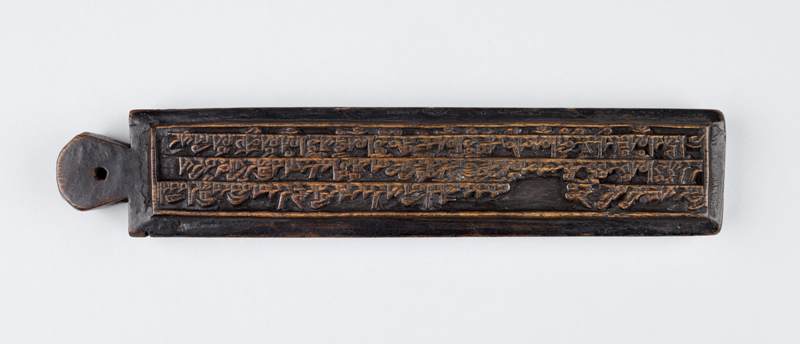
Ink was applied to the raised surface, and a sheet of paper was placed against the block. By rubbing or pressing the paper against the inked surface, the printer transferred the image of the text onto the sheet.
The finished pages retained the traditional pecha format, demonstrating how a new method of reproduction could be incorporated into an established literary tradition without fundamentally changing the physical form of the book.
Woodblock printing offered several important advantages. Once carved, a set of blocks could be used repeatedly to produce additional copies of a text. This made the reproduction of large collections more practical and helped support the establishment of monastic printing houses.
Among the most ambitious undertakings were printed editions of the Tibetan Buddhist canon, including the Kangyur, containing translations of teachings attributed to the Buddha, and the Tengyur, comprising an extensive collection of commentaries and scholarly works.
The production of these collections involved the coordinated efforts of calligraphers, editors, carvers, printers, papermakers, and patrons. A single major edition could require thousands of printing blocks and years of sustained labor.
The influence of printing extended beyond the monasteries. It contributed to the wider circulation of philosophical works, ritual texts, biographies, histories, medical treatises, and literary compositions throughout Tibetan cultural regions.
Yet printing did not eliminate the importance of handwriting. Calligraphers continued to prepare master copies for carving, produce manuscripts for special purposes, and preserve the artistic traditions associated with Tibetan script.
In this way, woodblock printing became not a replacement for Tibetan calligraphy, but another medium through which its forms could be reproduced and transmitted.
The Pecha as a Sacred Object
In Tibetan Buddhist culture, religious books have traditionally been regarded with a degree of reverence that extends beyond their informational content.
A scripture is understood as a support for the Buddha’s teachings, and its physical form is treated accordingly. Texts are commonly kept in clean, elevated places, protected from damage, and handled with care. Placing religious books directly on the floor or stepping over them is generally considered disrespectful.
This attitude is especially visible in the treatment of pechas within monasteries and temples. Volumes may be wrapped in fine cloth, placed on dedicated reading stands, or stored in elaborately decorated cabinets.
The act of reading a pecha can itself be part of a religious practice. Monks, nuns, and lay practitioners use these books for recitation, study, contemplation, and ritual performance. In certain ceremonies, numerous volumes may be brought out and read aloud by groups of practitioners.
The physical book therefore participates in the religious life of the community. It is an object that can be made, offered, preserved, studied, and venerated.
Commissioning the copying or printing of a sacred text has also traditionally been regarded as a meritorious activity. Patrons might sponsor the production of manuscripts or printed editions for monasteries, teachers, or communities, helping ensure that important teachings remained available to future generations.
These practices reveal an important dimension of Tibetan book culture: the preservation of knowledge was inseparable from a sense of responsibility toward the teachings themselves.
The Art of Pecha Covers and Wrappings
Although the pages of a pecha are its most important component, the materials used to protect them often represent significant works of craftsmanship in their own right.
Traditional wooden covers, sometimes called legshing, may be made from carefully selected timber and decorated with carved ornamentation, painted designs, or gilded surfaces. Some feature intricate floral patterns, auspicious symbols, or images of Buddhist deities.
The covers serve the practical purpose of protecting the loose leaves from bending and damage, but their decoration also expresses the importance of the text enclosed within them.
Textile wrappings provide another layer of protection. Depending on the resources available and the significance of the volume, these might range from simple cotton cloth to elaborate brocades.
Traditional book labels, sometimes attached to the wrapping or placed at the exposed end of a volume, identify the contents and facilitate retrieval from library shelves.
Taken together, the paper, writing, wooden covers, and textile wrappings create a complete object in which several traditional crafts converge. The pecha is thus not only a literary artifact, but also an expression of Tibetan woodworking, textile production, painting, and decorative art.
Pechas and the Great Monastic Libraries
The accumulation of written texts was central to the development of Tibetan monastic institutions. Major monasteries became centers of learning where extensive collections of Buddhist scriptures, philosophical commentaries, ritual manuals, biographies, and historical works were preserved.
These libraries could contain thousands of pecha volumes, organized according to textual collections, religious traditions, or scholarly subjects.
The traditional horizontal storage system gave Tibetan libraries a distinctive appearance. Rows of long, narrow volumes, often wrapped in colored cloth, filled wooden compartments extending across walls or entire rooms.
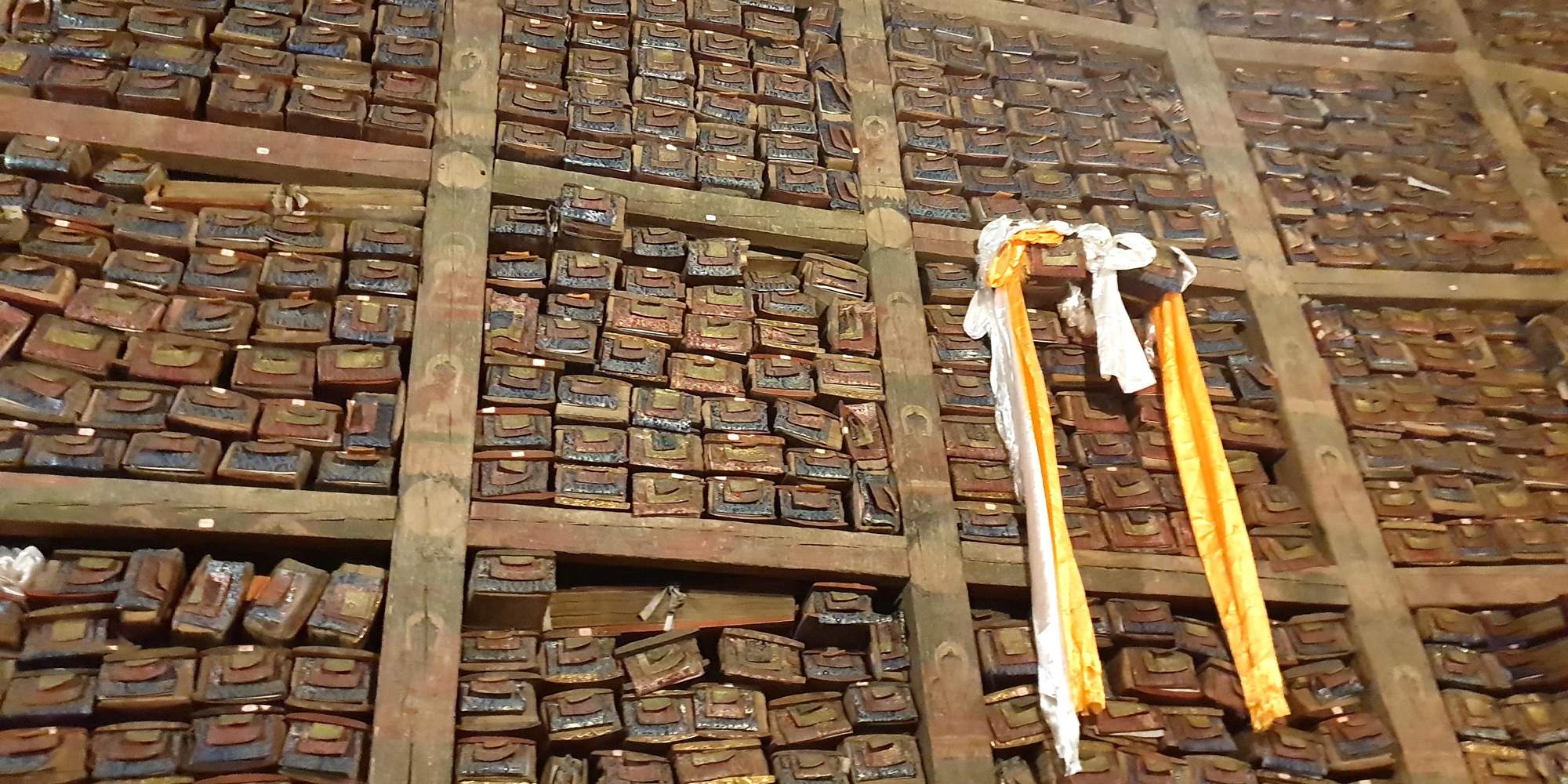
The preservation of these collections required continuous attention. Books had to be protected from moisture, insects, fire, and physical deterioration. Damaged pages might be repaired or recopied, while important works were reproduced to ensure their continued availability.
The political upheavals and destruction of cultural institutions in Tibet during the twentieth century resulted in the loss of many manuscripts, printing blocks, and libraries. At the same time, surviving collections in Tibet, Himalayan communities, and institutions around the world have become invaluable resources for the study and preservation of Tibetan literary heritage.
Today, conservation specialists, scholars, monasteries, and digital preservation projects are working to document and protect surviving materials. Their efforts help make historical texts accessible while safeguarding the physical artifacts that carry them.
The Pecha in the Modern World
Despite the widespread availability of modern bound books and digital publications, the pecha remains an important part of Tibetan cultural and religious life.
Traditional-format books continue to be produced for monasteries, ritual use, and personal practice. Some are printed using modern methods, while others are created through traditional woodblock printing or handwritten calligraphy.
The continued use of the pecha reflects more than an attachment to an inherited aesthetic. Its proportions, arrangement, and methods of handling have become deeply integrated into Tibetan practices of reading, recitation, and study.
At the same time, the pecha has attracted growing interest among artists, conservators, papermakers, and scholars who recognize its importance as a distinctive achievement in the history of the book.
For contemporary Tibetan calligraphers, the pecha offers a particularly meaningful connection to the past. Its elongated pages invite an approach to composition shaped by traditional proportions, disciplined letterforms, and an awareness of the relationship between writing and the material that supports it.
The revival and continued practice of traditional papermaking also offer opportunities to explore the physical qualities of historical manuscripts. Recreating the strength, texture, flexibility, and writing characteristics of handmade paper can deepen our understanding of the choices made by earlier generations of artisans.
Preserving a Living Tradition
The Tibetan pecha represents an extraordinary continuity of form and purpose. From the earliest manuscript traditions influenced by India to the great woodblock-printed collections of Tibet, its distinctive structure has served as a means of preserving knowledge across centuries.
Its history brings together the work of translators, scribes, calligraphers, papermakers, woodcarvers, printers, artists, and religious practitioners. Each contributed to the creation of books whose significance extended far beyond their physical materials.
For those of us who practice Tibetan calligraphy today, the pecha offers a reminder that writing has always been part of something larger. The shape of a letter, the movement of a pen, the preparation of a sheet of paper, and the careful arrangement of words all belong to a tradition devoted to preserving and transmitting meaning.
Although the methods of producing and reading books continue to evolve, the pecha remains a powerful symbol of the enduring relationship between craftsmanship, learning, and spiritual practice.
In its long, narrow pages, we encounter not only the history of Tibetan writing, but also the dedication of countless individuals who labored to ensure that the written teachings would survive for generations to come.
