




For centuries, the preservation and transmission of Buddhist teachings in Tibet depended upon an extraordinary collaboration between scholars, calligraphers, woodcarvers, papermakers, and printers. Long before modern printing technologies reached the Tibetan plateau, artisans had developed sophisticated methods of reproducing sacred texts through the meticulous craft of woodblock printing. This tradition made it possible to produce multiple copies of important Buddhist works while preserving the beauty and precision of Tibetan script.
Woodblock printing occupies a remarkable place in Tibetan cultural history. It represents more than a technological development in the reproduction of books. It is an art form in which the written word, religious devotion, and skilled craftsmanship come together. The printing blocks themselves, sometimes preserved for generations, became repositories of knowledge, ensuring that the teachings they contained could continue to reach practitioners and scholars far beyond the monasteries where they were produced.
The Origins of Woodblock Printing in Tibet
Woodblock printing originated in China, where the technique was already well established by the Tang dynasty (618-907). As Buddhist texts circulated throughout East and Central Asia, printing technologies gradually accompanied the spread of religious literature.
In Tibet, the earliest surviving evidence of woodblock printing dates to the period following the initial dissemination of Buddhism, although the precise chronology of its introduction remains a subject of scholarly investigation. Tibetan-language printed materials survive from the period of the Tangut kingdom of Western Xia (1038-1227), while printing activity within Tibetan cultural regions became increasingly prominent in subsequent centuries.
By the fifteenth century, woodblock printing had developed into an important means of reproducing Buddhist literature. Printing establishments associated with monasteries, religious communities, and regional patrons produced editions of scriptures, philosophical treatises, ritual manuals, biographies, and other works.

One of the most significant developments was the establishment of major printing centers, particularly in eastern Tibet. The printing house at Derge, founded in the eighteenth century, became especially renowned for the quality of its carved blocks and the extensive collections of Buddhist literature produced there.
The ability to reproduce texts in substantial numbers transformed the circulation of Buddhist knowledge. Whereas handwritten manuscripts required scribes to copy each page individually, a single set of carved printing blocks could produce many copies of the same work. This allowed important teachings to circulate more widely while maintaining a remarkable degree of textual consistency.
From Calligraphy to Carved Wood
The production of a Tibetan woodblock-printed text began not with the carving of wood, but with the careful preparation of its written content.
Before a printing block could be made, a skilled calligrapher or scribe prepared the text according to established conventions of Tibetan orthography and script. The proportions of the letters, spacing between letters, placement of punctuation, and arrangement of lines all required close attention.
The quality of this original manuscript was essential. Any irregularities in the writing could be reproduced in every subsequent impression, making the calligrapher’s work the foundation upon which the entire printing process depended.
The text was generally prepared in a form suitable for transfer onto a smooth wooden surface. Traditional methods involved adhering or transferring the written design to the block so that the carver could follow the outlines of the letters.
Because printing reverses the image on the block, the characters had to be carved in mirror image. Once ink was applied and paper pressed against the surface, the resulting impression would display the letters in their correct orientation.
This required extraordinary precision. Tibetan writing contains numerous fine details, including stacked consonants, vowel signs, and subtle variations in stroke thickness. A small error in carving could alter a letter’s appearance or, in some cases, change the meaning of a word.
The carver therefore had to possess more than technical woodworking ability. A familiarity with the structure of Tibetan script was invaluable, allowing the artisan to distinguish essential features of the letters and preserve the character of the original calligraphy.
The Art of Carving Tibetan Printing Blocks
The wooden blocks used for Tibetan printing were typically fashioned from carefully selected, seasoned timber. The wood needed to be sufficiently durable to withstand repeated printing while possessing a fine, even grain that permitted the carving of delicate letterforms.
The surface was planed and smoothed before the written design was transferred. Carvers then worked with specialized knives and chisels, gradually removing the wood surrounding the characters. The letters themselves remained raised above the recessed background.
This is known as relief printing, a technique in which ink is applied to the raised portions of a printing surface.
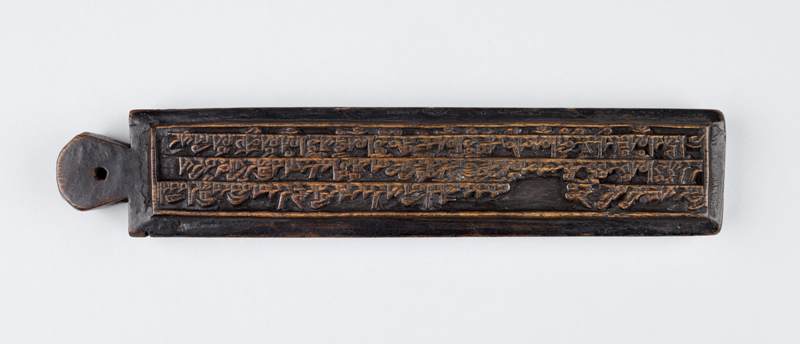
Carving Tibetan script demanded patience and a steady hand. The horizontal headstrokes characteristic of many Tibetan scripts, the descending elements of certain consonants, and the intricate relationships between stacked letters all presented challenges.
Particularly demanding were the small spaces within and between characters. Removing too much wood could damage a letter, while leaving excess material could produce unwanted marks during printing.
The finished block represented a precise translation of handwritten calligraphy into a durable printing surface. Although the original lettering had been created through the fluid movement of a pen, the carver reproduced its forms through the deliberate removal of wood.
In this way, two very different crafts became inseparable. The calligrapher established the visual language of the text, while the woodcarver transformed that language into a form capable of repeated reproduction.
Ink, Paper, and the Printing Process
Once the blocks were carved, the process of printing could begin. Traditional Tibetan woodblock printing relied upon relatively simple equipment, but achieving consistently clear impressions required considerable experience.
Ink was applied to the raised characters, commonly using a brush or other suitable applicator. A sheet of paper was then positioned over the inked surface and rubbed or pressed by hand to transfer the image.
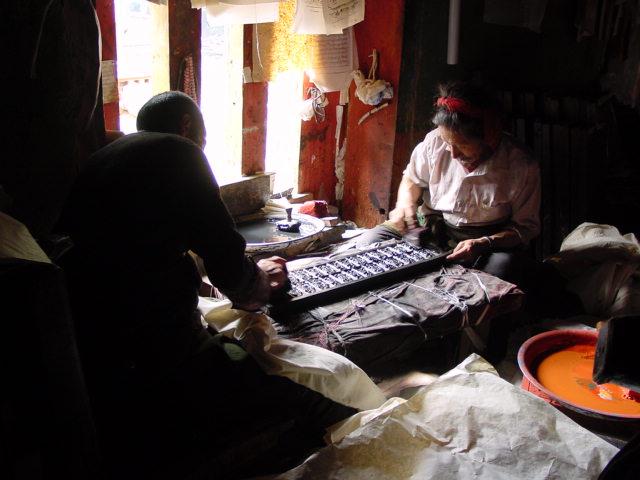
Unlike many Western printing techniques, which developed around mechanical presses, Tibetan woodblock printing traditionally relied on manual pressure. The printer’s skill was essential in ensuring that the ink transferred evenly without smearing or producing incomplete characters.
The paper itself played a crucial role.
Traditional Tibetan papermaking employed fibers obtained from various plants, including species of Daphne and Edgeworthia. These fibers could produce papers that were both strong and flexible, qualities particularly well suited to the long, narrow pages of Tibetan books.
The interaction between ink and paper required careful consideration. A sheet that absorbed ink too readily might produce blurred letterforms, while an excessively resistant surface could prevent a complete impression.
The ideal paper allowed the ink to transfer cleanly while maintaining the sharpness of the carved characters. Its strength also helped it withstand handling during printing, drying, and eventual use.
After printing, the sheets were dried and assembled in the traditional Tibetan book format known as the pecha. Rather than being bound along one edge like a modern book, pecha pages were generally stacked loosely between protective covers and wrapped in cloth.
This format was particularly compatible with woodblock printing. The long, rectangular printing blocks could accommodate the horizontal arrangement of Tibetan text, allowing entire pages to be reproduced in a single impression.
The Beauty of Printed Tibetan Script
One of the most compelling aspects of Tibetan woodblock printing is the way it preserves the aesthetic qualities of handwritten calligraphy.
Although printing introduces a degree of standardization, traditional Tibetan printed texts retain a distinctly calligraphic character. Their letters are not merely mechanical symbols. They reflect the proportions, rhythm, and stylistic decisions of the scribes whose writing served as the original model.
In many printed pechas, the horizontal movement of the script creates a strong visual continuity across the page. The headstrokes establish a sense of structure, while the descending and ascending elements introduce variation and movement.
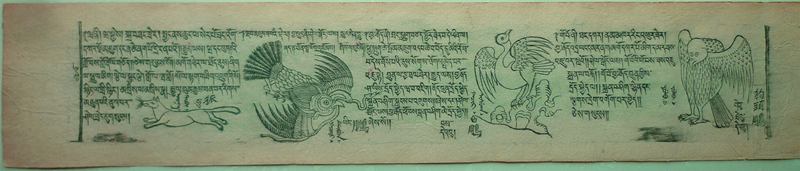
The relationship between the individual letters and the surrounding space is equally important. Carefully arranged lines create an impression of balance, allowing the reader’s eye to move naturally through the text.
Traditional Tibetan printing employed several script styles, with uchen, the headed script, particularly prominent in printed Buddhist literature. Its clearly differentiated letterforms and structured proportions made it well suited to the reproduction of complex religious texts.
The visual qualities of these printed works reveal how closely Tibetan calligraphy and printing remained connected. Even after a manuscript had been transformed into carved wood, the original calligrapher’s understanding of proportion, spacing, and composition continued to shape the finished page.
For those studying Tibetan calligraphy today, historical woodblock prints offer valuable examples of traditional letterforms. They preserve stylistic conventions and proportions that can be studied alongside handwritten manuscripts and contemporary calligraphic practice.
Derge Parkhang: A Living Tradition
Among the great institutions associated with Tibetan woodblock printing, few are as celebrated as the Derge Printing House, commonly known as Derge Parkhang, in present-day Sichuan Province, China.
Established in 1729 under the patronage of the Derge royal family, the printing house became one of the most important centers for the production and preservation of Tibetan Buddhist literature.
Its collections encompass a vast number of carved wooden blocks containing religious, philosophical, historical, and other scholarly works. Among its most significant publications are editions of the Kangyur, the collection of scriptures regarded as the translated words of the Buddha, and the Tengyur, the extensive collection of Indian Buddhist commentaries and treatises translated into Tibetan.
The scale of such undertakings is difficult to overstate. Producing a major canonical collection required the coordinated efforts of numerous scholars, editors, scribes, carvers, and printers, often working over extended periods.
Derge Parkhang is also remarkable for the survival of its traditional printing methods. Artisans continue to demonstrate and practice techniques that have changed relatively little over generations.
The printing process is highly coordinated. Workers apply ink to the blocks, position the paper, and transfer the impression through practiced movements. The resulting pages are then collected and dried before being assembled into books.
Beyond its practical function, the printing house stands as a testament to the extraordinary commitment Tibetan communities have made to preserving their literary and spiritual heritage.
Printing as an Expression of Buddhist Practice
Within Tibetan Buddhist culture, the production of sacred texts has traditionally been regarded as a meritorious activity.
Copying, printing, sponsoring, and distributing Buddhist scriptures are understood as ways of supporting the preservation and dissemination of the Dharma. The significance of such work extends beyond the physical objects produced, encompassing the intention and dedication of those involved.
A patron who financed the carving of printing blocks, a calligrapher who carefully prepared a manuscript, and a printer who reproduced its pages could all understand their contributions as part of a larger spiritual undertaking.
This perspective helps explain the extraordinary resources devoted to the creation of Tibetan Buddhist books. Some projects required years of labor and substantial financial support, yet their value was measured not simply in the number of volumes produced but in their potential to benefit future generations.
The care invested in the work also reflects a broader relationship between craftsmanship and Buddhist practice.
The repetitive, exacting nature of carving and printing demands sustained attention. Each stage requires the artisan to remain attentive to the task at hand, whether following the delicate outline of a letter or ensuring the clarity of an impression.
Although these activities are not necessarily meditation in a formal sense, they can embody qualities that Buddhist practice seeks to cultivate: patience, diligence, concentration, and conscientiousness.
In this respect, Tibetan woodblock printing shares something essential with the practice of calligraphy. Both transform the act of writing into an opportunity for careful attention, while serving the larger purpose of preserving and communicating meaning.
Preserving Knowledge Across Generations
The historical importance of Tibetan woodblock printing becomes especially apparent when considering the enormous body of literature preserved through the tradition.
Tibetan Buddhist civilization produced an extensive written heritage encompassing philosophy, logic, medicine, astronomy, grammar, poetry, history, ritual, and contemplative instruction.
Many of these works circulated through networks of monasteries and scholarly institutions, where printed editions provided important resources for study and teaching.
The durability of carved wooden blocks offered a particular advantage. Unlike a handwritten manuscript, which had to be copied anew each time another copy was needed, a set of printing blocks could be stored and reused whenever additional volumes were required.
Some collections remained in use for generations, allowing texts to be reproduced long after the deaths of the scholars and artisans who originally prepared them.
Of course, the survival of this literature was never guaranteed. Fires, warfare, political upheaval, environmental damage, and the gradual deterioration of materials all threatened manuscripts and printing blocks throughout Tibetan history.
The preservation of surviving blocks and printed editions is therefore of immense cultural importance. These objects provide not only access to the texts they contain but also evidence of historical practices in calligraphy, bookmaking, craftsmanship, and religious patronage.
In some cases, the physical characteristics of a printed page can reveal details about its origins, including the style of its lettering, the arrangement of its text, and the conventions employed by a particular printing establishment.
Such features make historical Tibetan books valuable to scholars of art, religion, linguistics, and material culture alike.
Tibetan Woodblock Printing in the Modern World
The introduction of modern printing technologies dramatically changed the production of Tibetan books.
Digital typesetting, offset printing, and contemporary publishing methods have made it possible to reproduce Tibetan texts more quickly and economically than traditional woodblock printing ever could.
These developments have expanded access to Tibetan literature, allowing scriptures and scholarly works to circulate internationally in both printed and digital formats.
Yet traditional woodblock printing retains an importance that cannot be measured solely in terms of efficiency.
The carved blocks, handmade papers, and manually printed pages preserve a direct connection to centuries of Tibetan craftsmanship. They demonstrate how generations of artisans approached the written word, not merely as information to be reproduced, but as something deserving of extraordinary care.
Preservation efforts, historical research, and the continued practice of traditional printing techniques help ensure that this knowledge is not lost.
For contemporary calligraphers, the tradition also offers an important reminder that Tibetan script has never existed in isolation from the materials and technologies used to reproduce it. The shape of a letter is influenced by the pen that writes it, the surface that receives it, and, in the case of woodblock printing, the tools that carve it into wood.
Understanding these relationships enriches our appreciation of Tibetan writing as both a linguistic system and a living artistic tradition.
A Lasting Impression
There is something remarkable about the journey of a single line of Tibetan writing through the woodblock printing process.
What begins as a movement of the calligrapher’s hand becomes a design transferred to wood. Through the patient work of the carver, that design is transformed into a raised surface. Ink and paper then bring the letters into view once again, allowing the original forms to appear across countless pages.
The process is at once practical and deeply expressive. It transforms an individual act of writing into a means of communicating across distances and generations.
Today, the surviving printing blocks and traditional books of Tibet remind us that the preservation of knowledge depends not only upon ideas, but also upon the hands and materials through which those ideas are transmitted.
In every carefully carved character and every printed page, we encounter the enduring relationship between Tibetan calligraphy, craftsmanship, and the preservation of the Dharma.
Top photo: Karl Debreczeny
